Category Archive: Site Protection
Toronto has put real money behind protecting community spaces from vehicle attacks. The City’s Hostile Vehicle Mitigation (HVM) Grant offers eligible organizations up to $100,000 each from a $2.5 million fund to assess, design, and install crash-rated protection like bollards, gates, and reinforced street furniture.
The application window closed on March 2, 2026, and the City is expected to fund at least 25 organizations. If your organization applied, here is what comes next. If you missed the window, there is still significant funding available from other levels of government, and we cover that below too.
What the Grant Covers
The grant is specific to physical measures that stop vehicles. Eligible expenses include:
- Permanent crash-rated bollards, fixed or retractable
- Crash-rated fencing and gates
- Reinforced, crash-rated street furniture such as benches and planters designed to stop vehicles
- Upgrades to existing infrastructure to meet current crash-rating standards
- Threat, Vulnerability, and Risk Assessments (TVRA), site surveys, and engineering studies
- Design, installation, and permit costs
One requirement stands out: barriers that are not crash-rated are explicitly ineligible. Decorative bollards and standard planters will not qualify. Products must be certified to recognized impact standards such as ASTM F2656, ISO 22343-1, IWA 14-1, or PAS 68, verified by an independent testing agency.
Who Was Eligible
- Incorporated non-profits and charitable organizations based in Toronto
- Organizations serving communities at risk of hate-motivated incidents or crimes, including places of worship, cultural community organizations, faith-based schools, and childcare centres
- Property owners, or tenants with long-term occupancy and the owner’s support
How the Process Works
The grant runs in two phases. First, the City funds a Threat, Vulnerability, and Risk Assessment prepared by a Qualified Security Consultant. That assessment determines whether HVM is warranted and what level of protection the site needs. Second, the City releases the remaining funds, up to the $100,000 total, for design, permits, product, and installation.
Funded organizations have one year to complete their project, and every expense must be pre-approved by the City. Vendor quotes are required as part of the Phase Two application, and the City encourages competitive quotes rather than sole-sourcing.
The Requirements That Trip People Up
The City’s Hostile Vehicle Mitigation on City Streets guidelines set a high bar. A few things to plan for:
- Certification proof. You need a crash test report or third-party certificate for every rated product. The City specifically warns applicants about vendors using vague language that implies certification without formal testing.
- Private property first. HVM must go on your own property wherever feasible. Encroaching on the sidewalk or boulevard requires a justification letter, an HVM permit, and an encroachment agreement with the City.
- Accessibility. Installations must comply with AODA. Standard pedestrian clearway is 1.5 metres, and tighter bollard spacing is only accepted where the security assessment justifies it.
- Maintenance. Owners are responsible for upkeep for the life of the installation, and maintenance documentation is part of the application.
Missed the Toronto Grant? Federal Money Is Still Open
The Canada Community Security Program is accepting applications on a continuous, first-come first-served basis. It covers up to 70 percent of eligible costs to a maximum of $1.5 million per project for communities at risk of hate-motivated incidents, and it applies across Canada, not just Toronto. Bollards are eligible where there is a credible risk of vehicle ramming near gathering spaces, and mechanical bollards were added to the eligible list for 2026-27.
Ontario also runs the Anti-Hate Security and Prevention Grant, which offers smaller amounts for security upgrades. The three programs can be stacked, with each covering costs the others do not.
What a Typical Project Looks Like
The City’s own budgetary estimates put a certified bollard at roughly $9,000 to $19,000 installed depending on foundation type. In practice, a $100,000 grant typically covers the assessment plus a protective array of six to eight crash-rated bollards, or a mix of bollards with a crash-rated gate at a driveway entrance.
How Ontario Bollards Can Help
We supply certified, crash-rated bollards and vehicle barriers with the third-party test documentation the City requires, and we work with security consultants, engineers, and installers across the GTA every day. Whether you are a grant recipient assembling quotes for your Phase Two application, or an organization exploring the federal program, we can help you scope the right products for your site and budget.
Get in touch for a quote or a no-pressure conversation about your site.
How Far Apart Should Bollards Be Placed?
A Guide for Landscape Architects & Security Specifiers
Quick Answer: Typical Bollard Spacing at a Glance
-
Most sites: Place bollards 3–5 feet (0.9–1.5 m) apart, measured from the center of one post to the next.
-
Accessibility (ADA): Leave at least 36 inches (0.9 m) of clear space for wheelchairs and walkers.
-
Vehicle safety: Gaps should be no larger than 5 feet (1.5 m). For high-security areas, reduce spacing to 4 feet (1.2 m) or less.
-
Important: Always check local building codes before finalizing your layout.
Why Spacing Matters: People, Safety, and Design
Good bollard placement is about balance:
-
People first: Bollards should allow smooth pedestrian flow, including those using wheelchairs, strollers, or mobility aids.
-
Safety: They must be close enough to stop vehicles from sneaking through, especially in front of storefronts, schools, or public plazas.
-
Design: Bollards should line up neatly with benches, trees, planters, and lights. This makes the space look organized and welcoming.
Your goal matters too. A storefront protection line will need tighter spacing than a decorative walkway on a campus.
Spacing Rules by Application
Pedestrian & ADA Access
-
Keep at least 36 inches (0.9 m) of clear width for accessibility.
-
In busy areas, give a little more room (42–48 inches) for comfort.
-
Always measure from the outside of the sleeve or cover — not just the post.
Vehicle Deterrence & Storefront Protection
-
Standard safety: Gaps no larger than 5 feet (1.5 m).
-
Higher risk: Tighten to 4 feet (1.2 m) or less.
-
Match spacing to the likely vehicle approach angle and speed.
Sidewalks Next to Parking
-
Set bollards back about 1.5 feet (0.45 m) from the curb.
-
This gives people enough space to open car doors.
-
Leave extra room near accessible parking spaces.
Campuses, Schools, and Plazas
-
Use a steady rhythm of 4–5 feet (1.2–1.5 m) apart.
-
Keep clear “desire lines” where people naturally walk.
-
Make sure emergency vehicles can still get through.
Utility and Asset Protection
-
For sensitive equipment, keep bollards 4 feet (1.2 m) or closer.
-
Consider adding rails or barriers for extra protection.
-
Don’t block maintenance crews from reaching equipment.
Spacing Summary Table
| Use Case |
Recommended Spacing |
Notes |
| Pedestrian / ADA |
≥36 in (0.9 m) clear width |
Measure at narrowest point |
| Vehicle Deterrence |
≤5 ft (1.5 m) gap |
≤4 ft (1.2 m) for higher risk areas |
| Sidewalk by Parking |
~1.5 ft (0.45 m) from curb |
Allows car doors to open |
| Campuses / Plazas |
4–5 ft (1.2–1.5 m) |
Comfort + natural walking patterns |
| Utilities / Assets |
≤4 ft (1.2 m) or add rails |
Based on asset importance |
Codes and Standards (Simplified)
-
ADA (Accessibility): At least 36 inches of clear space for people using mobility devices. Local versions may add more rules.
-
ASTM F2656 (Crash Testing): A U.S. crash standard. Some tested bollards only work if placed in a certain pattern — always follow manufacturer instructions.
-
Building Codes: Check International Building Code (IBC) and local rules for exits, sightlines, and fire department access.
-
Traffic Standards (MUTCD): Guidelines for bollards near crosswalks, schools, and intersections.
Note: Local planning departments have the final say. Always confirm with them before construction.
Layout Details: Lines, Corners, and Openings
-
Measurement: Measure from center to center. Don’t forget the sleeve width.
-
Corners: Place bollards closer together to stop diagonal vehicle movement.
-
Access Points: Leave 6–8 feet for gates, deliveries, or emergency access. Use removable or automatic bollards where needed.
-
Site Planning: Check for drainage, underground utilities, snow removal, and seasonal furniture.

Common Mistakes to Avoid
-
Measuring wrong: Forgetting to include sleeves or covers. Always measure the narrowest clear opening.
-
Corner gaps: Leaving wide angles that vehicles can cut through. Tighten bollards at corners.
-
Curb clearance issues: Placing bollards too close to curbs so car doors can’t open. Keep that 1.5-foot offset.
-
Code conflicts: Meeting one rule but breaking another. Always design to the strictest code.
Frequently Asked Questions
Q: What is the standard distance between bollards?
A: Usually 3–5 feet apart, depending on security and accessibility needs.
Q: What is ADA-compliant clear width?
A: At least 36 inches (0.9 m) between bollards at the narrowest point.
Q: How close should bollards be for vehicle safety?
A: No more than 5 feet (1.5 m) apart. High-security areas should be 4 feet (1.2 m) or less.
Q: How far back from the curb should bollards be?
A: About 1.5 feet (0.45 m) to allow doors to open.
Q: Do decorative sleeves change spacing?
A: Yes. Measure spacing at the outer edge of the sleeve, not the post.
Getting Started: Your Next Steps
Checklist before finalizing your design:
-
Clear width meets ADA rules
-
Local codes verified
-
Vehicle gaps under control
-
Corners secured
-
Emergency access allowed
-
Utilities and drainage checked
Ontario Bollards’ Perimeter Protection Team has extensive experience with both crash-rated and architectural bollards. Need help with your next project? Contact our team for site-specific support.

If you have perimeter protection needs, contacting Ontario Bollards should be your first step—for a host of compelling reasons.
Experience
With more than 30 years of experience in the construction industry, our team has a broad range of knowledge about construction-related projects and processes. We understand which materials, constructions, and installation methods work best for each application. From our headquarters in Georgetown, Ontario and office in Williamsville, New York, we have provided site-specific safety and security solutions for countless clients throughout North America in a broad spectrum of industries. As a result, we’ve collaborated with security specifiers, architects, engineers, contractors, project managers, property managers, and end-users to provide solutions that are both functional and attractive. We are the premier experts in North America on the design, construction, installation and servicing of asset protection products for all situations. There’s no substitute for experience and ours is unrivalled.
Products
Fundamental to the success of Ontario Bollards is our extensive materials inventory for bollard construction, which allows us to provide you with a quick turnaround on your project. On the rare occasions that Ontario Bollard cannot fabricate the specific solution required by a unique or complex application, we make use of our extensive network of partner facilities to help meet those needs. Our portfolio of material suppliers and fabricators share our commitment to producing the best asset protection solutions available. Consequently, we have the capacity to meet your every need.
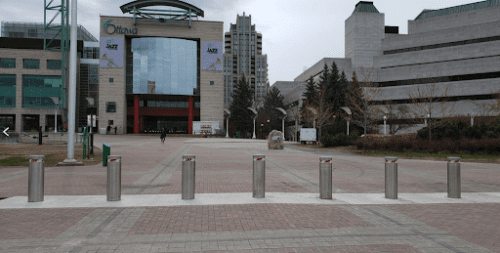
Ontario Bollards provides an extensive array of bollards, including:
- Anti-Terrorism (K-Rated) Bollards: Stop big trucks in their tracks.
- Retractable Bollards (Semi-Automatic and Automatic Hydraulic models): A secure and affordable option for access control.
- Removable Bollards: Ideal for locations with changing access needs.
- Manual Bollards: Clean and versatile design; available with alternative mountings, including retractable and removable options.
- Surface-Mount/Bolt-Down Bollards: Protect utilities, electronics, machinery, buildings or pedestrians from accidental collisions.
- Bollard Covers: An easy and inexpensive way to beautify security posts and protect them from the elements.
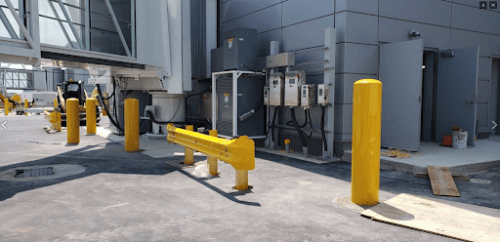
Ontario Bollards also provides SpringPosts, bollards that spring back upright after impact, as well as Polymer Barrier Systems, designed to protect doors or protruding corners from accidental impacts with forklifts and other moving vehicles.
Single-Source Solutions
Ontario Bollards provides turn-key perimeter protection systems tailored to your specific requirements. We do it all. We can help you:
- Assess your current damage protection strategy and your unique requirements.
- Identify weak points in your current damage protection program.
- Create a custom plan that addresses the weak points.
- Provide the products outlined in the plan.
- Promptly and expertly install the products.
- Conduct maintenance and repairs as required.
By professionally providing all these services at competitive prices, we make protecting your people, products, operations and profits simple and stress-free.
Contact
If you have perimeter protection needs, we’d love to hear from you. We know we can help. Click here to contact us.

Summer in Canada brings longer days and warmer temperatures, it also brings with it an unwanted side-effect: record-high rates of vehicle theft. Reaching epidemic proportions in Canada with theft rates in Toronto nearly doubling since 2015, a vehicle is now stolen every six minutes according to the Insurance Bureau of Canada.
The Toronto Police Department reported 5,666 vehicle thefts in 2020, capping a five-year upward trend. TPS also reported that the majority of thefts occurred on weekdays, with a high concentration of thefts taking place between 7 pm and 10 pm. Commercial vehicle thefts saw a 0.3% increase according to these findings, while residential vehicle thefts were up a whopping 13.5%. Despite the daunting statistics, vehicle theft is preventable, and the team at Ontario Bollards has put together a list of tips to greatly reduce the risk of property loss.
Park defensively
The simplest defense against vehicle theft can sometimes be a careful parking job. A locked garage is always the safest place for a vehicle, but should one not be available then more strategic parking is a must. For starters, thieves are not too fond of the spotlight, so parking a vehicle in a well-lit area will help deter a theft. When parking two vehicles, it is wise to park in a way that ensures one vehicle is guarding the more valuable (and therefore more susceptible) vehicle. Dedicating a few minutes to ensuring a vehicle is parked strategically may be the difference between a safe vehicle and a stolen one.
High-tech, lower risk
 As thieves get more cunning, a high-tech approach to vehicle defense becomes more necessary. Simple tools like a steering-wheel lock prevent theft by making a vehicle impossible to steer should a successful break-in take place. Immobilizers are a tool that prevents the engine from running unless the correct key is present. This prevents the vehicle from being “hot wired” and reduces vehicular theft. While these less complex measures are effective, vehicle owners should also install GPS trackers on vehicles and store key-fobs in signal-blocking pouches (Faraday bag or cage) to guard them against hacking. Clearly visible security cameras pointed directly at the vehicle(s) can also deter potential thieves, or at very least provide documentation should a successful theft occur.
Think like a thief!
To prevent theft, vehicle owners should begin thinking like a thief. A quick trip into a coffee shop or running back into the house to grab a wallet (or a mask) with an unlocked or even running car may seem harmless, but it could present a golden opportunity for a thief to strike. Valuables should be removed or hidden, and vehicles should be locked whenever a vehicle is left unattended, no matter how brief. While Canadians would all like to put their faith in others, with theft rates at a record high it is not worth the risk.
Learn from the professionals!
Although residential vehicular theft in 2020 was up 13.5% over the previous year, commercial thefts remained largely unchanged. The defining factor? Bollards. Bollards have been used for decades to protect tractors and other heavy machinery, and car dealerships count on them to protect vehicles from theft while also offering access to inventory when needed. In addition to preventing theft, bollards are cost-effective and are a safety barrier that prevent vehicles from causing accidental or intentional damage to property—making them a valuable asset to car dealerships. With Canadian vehicular theft at an all-time high, however, more and more individuals are now relying on bollards for private residences as well.
Guard vehicles with Ontario Bollards
 Immobilizers, alarms, and high-tech security systems are a strong defense, remember that bollards are the ultimate protective measure. With over 35 years of industry experience, Ontario Bollards is Canada’s premiere resource for asset security solutions. Sleek, stainless steel removable and retractable bollards from Ontario Bollards provide unbeatable protection while offering convenient access to vehicles when needed. With thefts reaching a fever pitch, vehicle security is more crucial than ever. Fortunately, even the most brazen of thieves are deterred by Ontario Bollards. “Car dealerships have been using them forever,” said president of Ontario Bollards Danny Zanchi. “They’re commonplace in Europe and they are becoming more popular here.”
Furthermore, Ontario Bollards can install retractable bollards in residential driveways to prevent car theft. Here is the story of one of our clients, who had a vehicle stolen, so they hired Ontario Bollards to install a set of retractable bollards to prevent any possibility of future theft:
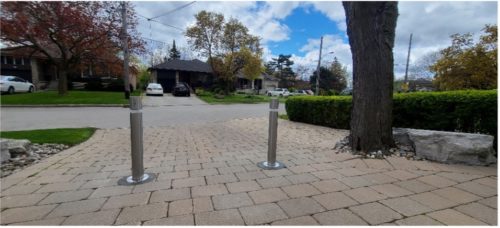
The installed retractable bollards on the driveway
“I recently woke up to discover that my wife’s car had been stolen right out of our home driveway. Needless to say it’s a gut wrenching experience; that leaves you feeling violated and exposed at your own home.
I decided to look into the idea of residential Retractable Bollards and after making a few calls to educate myself on the cost and details of installing these bollards…
Eventually I called Ontario Bollards and got on a call immediately with a young man named Nate. I must tell you that I was SO impressed with the customer service side of your company (Nate is absolutely terrific).
The workmanship was EXCELLENT!! No mess! No fuss! Just excellent execution on all counts!
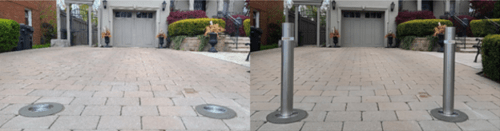
The installed retractable bollards. Retracted (left)/In Use (right)
I’m really so impressed with your company and your team; and I just wanted to let you know that I would be happy to be a reference anytime you might have a new client that wants to hear how MY experience went.
I would highly recommend Ontario Bollards to anyone that is looking to find a way to secure your home driveway from auto theft.”
-Darrin Jones, Ontario Bollards Customer
Do not be another statistic. Being proactive rather than reactive in regard to vehicular theft can save heaps of headache (and heartache) in the long-run, and a bollard solution from Ontario Bollards is the most effective way to guard against vehicular theft. For more information on how Ontario Bollards can help keep your vehicles safe, dial us at 844-891-8559 or send an inquiry to info@ontariobollards.com and our team of our experts will be glad to help.
A Guide to Site Protection With Bollards
Whether you need bollards because of building or fire codes, the design of the building, traffic patterns, or safety concerns, you want to ensure you are getting the right product for your site requirements. From crash rated bollards to traffic pattern indicators, bollard design is critical in providing the ideal protection for your building. To find the right barrier for your project, our team at Ontario Bollards shares the following information.
Key Bollard Considerations
Safety bollards are an excellent way to provide guidance for traffic flow, protection for pedestrian traffic, and an additional security measure for the building entry. However, despite their efficacy as visual and physical guides for vehicles, particularly in public venues, they are often overlooked.
When these robust, reinforced metal posts are placed in front of buildings or other outdoor spaces, it not only cues drivers where to go, but provides a safe space for pedestrian walkways and protects storefronts. Gate bollards can be used to seal off roads, bike paths, or walking trails, while parking bollards can prevent drivers from accidentally rolling too far past the parking spaces.
To select the right bollard for your needs, consider the following factors for your site:
- Behavior of drivers
- Design of building and road
- Frequency of traffic
- Types of traffic
Types of Bollards & Their Advantages
The strongest bollards are steel pipe reinforced with concrete and installed in a concrete substrate. Collapsible or retractable bollards can allow vehicle access from specific directions while preventing access from others without removing them.
You may choose to install a permanent crash rated, high impact bollard to prevent vehicles from hitting pedestrians or damaging property. If you are using bollards to section off areas, a low impact bollard may be a better choice. For multi-use areas, consider removable bollards.
Regardless of the design and installation, there are many benefits to using bollards on your site:
- Protect drivers: Traffic bollards separate opposing traffic patterns on roadways and limit speed in dangerous areas.
- Light up dark spaces: Lighted bollards are often used around parks and near buildings to illuminate walkways at night.
- Prevent access: Bollards can be used either permanently or temporarily to designate pedestrian access or construction areas.
- Enhance appearance: The aesthetic appeal of bollards is vastly underrated. Design, placement, color, and lighting can highlight and enhance the look of both architecture and landscaping.
- Protect storefronts: You can protect storefronts from wayward vehicles with concrete reinforced steel pipe bollards. If the look doesn’t appeal to you, there is always the option for more attractive bollard covers.
Quality Safety Solutions From Ontario Bollards
Since bollards create not only a physical but also a visual barrier, it is essential to choose a supplier who offers options in the shape, size, design, and function while providing professional guidance on the appropriate decisions for the site and application.
Ontario Bollards has been an industry leader in asset protection, providing bollards in various materials, designs, and safety ratings for almost 40 years. Our goal is to find the balance of safety and aesthetics to optimize the experience for visitors to your site.
For more information on our capabilities, products, or projects, contact us today. To request a quote, submit via the online form.