
Bolt-Down vs. Embedded Bollards: Are You Actually Protected?
Comments Off on Bolt-Down vs. Embedded Bollards: Are You Actually Protected?Bolt-Down vs. Embedded Bollards: Are You Actually Protected?
Short Answer:
Bolt-down bollards (also called ‘surface-mounted bollards’) are anchored to an existing concrete surface and are best suited for low-speed, controlled environments like warehouses or equipment protection zones.
Embedded bollards are installed deep into a concrete foundation – typically 36 to 48 inches – and are designed to stop vehicles and provide real impact protection. If a site involves active traffic, such as parking lots, storefronts, EV chargers, or pedestrian areas, embedded bollards are typically the safer choice.
One of the most common misconceptions about bollards is that they all do the same job.
If a steel post is installed in front of a building, EV charger or walkway, it must be protecting the space behind it, right?
Not necessarily.
The installation method determines how much protection a bollard actually provides.
Two bollards that look nearly identical above ground can perform very differently when struck by a vehicle.
This is where many property owners get into trouble. Installing the wrong type of bollard can create a false sense of security, leaving people, buildings, and expensive equipment far more vulnerable than expected.
Understanding the difference between bolt-down bollards and embedded bollards is the first step in choosing the right protection.

The Difference Explained
At first glance, bolt-down and embedded bollards look almost the same. The real difference is what’s happening below the surface.
Embedded Bollards
Embedded bollards are installed deep into the ground, typically 36 to 48 inches into a concrete foundation. This depth creates a strong anchor point that allows the bollard to absorb and redirect the force of a vehicle impact.
Because of this foundation, embedded bollards are designed to stop vehicles and provide real impact protection.
Bolt-Down Bollards
Bolt-down bollards (also called surface-mounted bollards) are attached directly to an existing concrete slab using heavy-duty anchor bolts.
They do not extend deep into the ground and rely entirely on their anchors for strength.
This design makes bolt-down bollards:
- Faster to install
- More affordable
- Easier to relocate if layouts change
However, it also means they provide much less impact resistance. In most cases, bolt-down bollards act as visual deterrents and low-speed protection, not vehicle-stopping barriers.
When real stopping power is required, the foundation is what matters, and embedded bollards provide it.
EV Charger Protection (Where Mistakes Are Happening Right Now)
EV charging stations are being installed everywhere: retail plazas, office parks, condos, municipal parking lots and highway rest stops.
To protect them, many property owners install surface-mounted bollards around the chargers.
The problem is the environment these chargers sit in.
Parking lots are active traffic areas where vehicles commonly move 15–30 km/h or more. Pedal confusion, distracted driving, and reversing errors are surprisingly common in these spaces.
When a vehicle strikes a bolt-down bollard at moderate speed, the most common outcome is predictable:
- Anchor bolts shear or pull out of the concrete
- The bollard tips or collapses
- The vehicle continues forward into the charger
Commercial EV chargers aren’t cheap.
Depending on the model and installation, replacement costs can easily range from $5,000 to $50,000+, not including electrical work, downtime, and insurance complications.
In environments like these, embedded bollards are the appropriate solution. The combination of vehicle speeds and equipment value demands real impact protection, not just a visual barrier.
Storefront Protection
Vehicle-into-building crashes occur thousands of times every year across North America.
According to safety research, vehicle-into-building crashes occur more than 20,000 times per year in the U.S. alone.
The causes are rarely dramatic. Most involve everyday situations such as:
- Pedal confusion
- Medical emergencies
- Distracted driving
- Impaired driving
- Vehicles reversing, instead of braking
Buildings located directly beside parking lots or roadways are particularly vulnerable.
When a vehicle travels at typical parking-lot or roadway speeds, surface-mounted bollards simply are not designed to stop that impact.
This is where the difference between bolt-down and embedded installations becomes critical.
In these environments, bollards are often protecting people.
- Storefronts
- Restaurants
- Grocery stores
- Other public-facing buildings
Protection here isn’t just about property; it’s about life safety.
Embedded bollards create a physical barrier that can stop a vehicle before it reaches the building.
Many municipalities and insurers are becoming increasingly aware of this risk, and requirements for proper storefront protection are growing.
Daycares and Schools
Few environments demand more careful risk management than schools and childcare facilities.
These spaces are often located close to parking lots or roadways:
- Playgrounds
- Pickup zones
- Pedestrian areas
And when children are involved, there is no acceptable failure scenario. A surface-mounted bollard that fails on impact near a playground is an unthinkable outcome.
For this reason, embedded bollards are the only appropriate choice for daycare and school perimeter protection.
Municipal guidelines and insurance policies are increasingly recognizing this need, and many facilities are upgrading protection accordingly.
In these environments, the investment in proper installation isn’t just about compliance; it’s about ensuring that the barrier actually performs when it matters most.
Warehouse and Industrial Environments (Where Bolt-Down Bollards Shine)
Bolt-down bollards are not inherently “bad.” They’re simply designed for a different type of environment.
In warehouses and industrial facilities, traffic is typically controlled and predictable. Operators are trained, speeds are low, and vehicles like forklifts and pallet jacks move at roughly walking pace — usually under 8 km/h.
In these conditions, surface-mounted bollards are often the ideal solution.
They effectively protect:
- Racking systems
- Electrical panels
- Equipment and machinery
- Doorways and loading areas
- Pedestrian walkways
Low-speed bumps and nudges are exactly what bolt-down bollards are designed to handle.
They also offer practical advantages in industrial settings:
- Layouts can change as operations evolve
- Bollards can be relocated without cutting into the slab
- Large facilities can install protection cost-effectively at scale
In a controlled environment, bolt-down bollards aren’t a compromise. They’re the right tool for the job.
Match the Bollard to the Threat
Choosing the right bollard starts with understanding the type of risk you’re trying to prevent.
As a simple rule:
Embedded bollards are best for:
- Storefront crash protection
- EV charger protection
- Daycares and schools
- High-traffic parking lots
- Any environment where vehicles travel at moderate speeds
Bolt-down bollards are best for:
- Warehouses and industrial facilities
- Equipment protection
- Interior safety zones
- Controlled environments with low-speed traffic
A bollard that looks protective but can’t actually stop a vehicle can be more dangerous than having no bollard at all, because it creates the illusion of safety.
Book a free site assessment
At Ontario Bollards, we start every project with a site assessment to evaluate traffic patterns, speeds, and risk factors before recommending a solution. We can help you choose the right protection for your specific situation.
Contact: 289 891 8559 info@ontariobollards.com
The Right Bollard for the Right Ground: Installation Best Practices by Surface Type
Comments Off on The Right Bollard for the Right Ground: Installation Best Practices by Surface TypeThe Right Bollard for the Right Ground: Installation Best Practices by Surface Type

Short Answer
The right bollard depends on the surface it’s installed into. Concrete supports all bollard types and provides the strongest foundation. Retractable bollards require full excavation and drainage planning regardless of surface.
Asphalt is not strong enough to hold bollards. For embedded or removable bollards, especially, you must dig through the asphalt and set them in concrete below. Bolt-down bollards should not be installed in asphalt at all.
A proper site assessment ensures the bollard and the ground work together to provide lasting protection.
Not All Ground Is Created Equal
Choosing the wrong bollard for the surface – or vice versa – is one of the most common and costly installation mistakes on commercial properties.
A bollard’s performance is not determined by steel alone. Ground conditions directly affect impact resistance, anchor integrity, long-term durability and safety. Concrete, asphalt, compacted base, drainage conditions, and freeze-thaw exposure all affect how well a bollard performs over time.
The right solution starts with knowing what lies beneath the surface. (It’s why Ontario Bollards will conduct a full site assessment before recommending any product).
In this article, we break down four common bollard types and explain where each one works best:
- Fixed embedded bollards
- Bolt-down bollards
- Removable bollards
- Retractable bollards
Understanding surface compatibility prevents premature failure, unnecessary rework, and avoidable liability.
Fixed Embedded Bollards
The Gold Standard for Permanent Protection
Fixed embedded bollards provide the highest level of permanent protection. These are the bollards for sites that require real impact protection.
- Building perimeters and storefronts
- Parking lot islands
- Electrical transformers and gas stations
Installation
Fixed embedded bollards are installed by excavating below grade and encasing the post in concrete. Once installed properly, they provide strong, permanent protection.
Best installed into:
- Concrete surfaces
- Compacted granular base
- Properly prepared asphalt sites where excavation reaches a stable sub-base
Concrete is the ideal host surface. It allows for clean core drilling and solid anchoring. When installed through asphalt, the asphalt layer must be cut through, so the bollard can be embedded into concrete below. Asphalt alone will not provide sufficient structural support.
Not suitable for:
- Soft or unstable ground without sub-base preparation
- Areas with high water tables without proper drainage consideration
Once installed, fixed embedded bollards are permanent. Placement must be planned carefully.
Bolt-Down Bollards
A Surface-Mounted Solution
Bolt-down bollards are not designed for high-impact protection. They’re best suited for:
- Retrofits on existing concrete pads.
- Indoor warehouse applications
- Areas where excavation is not feasible
Where real perimeter protection is required, fixed embedded bollards are the better choice.
Installation
Bolt-down bollards are surface-mounted using anchor bolts. They do not embed into the ground. Their performance depends entirely on the integrity of the surface material.
Best installed into:
- Concrete only
Concrete provides the compressive strength and structural stability needed to maintain anchor bolt tension during impact. Without sufficient slab thickness and strength, bolt-down installations are compromised.
Do not install bolt-down bollards in asphalt.
Asphalt is a flexible, temperature-sensitive material. It shifts with heat and cold, cracks under stress, and does not provide adequate resistance for anchor bolts. Over time, asphalt will pull away from the anchors, weakening the entire system.
Also not suitable for:
- Pavers
- Thin slabs
- Surfaces without adequate depth and compressive strength
A common mistake is choosing bolt-down bollards for asphalt parking lots because they appear easier to install. Without proper surface conditions, they will not perform as intended.
A site assessment prevents this mistake before installation begins.
Removable Bollards
Flexible Protection Without Compromise
When flexibility is required, removable bollards provide a strong solution, but only when installed into a stable and well-prepared base. The ideal applications include:
- Event venues
- Fire lanes
- Loading docks
- Seasonal access points
Installation
Removable bollards use a sleeve or receiver system. The sleeve is permanently installed in the ground, and the bollard drops into place and locks when needed. The sleeve is what determines surface compatibility.
Best installed into:
- Concrete The sleeve is core-drilled and set into concrete for a clean, secure installation
- Asphalt installations are possible but require preparation. The sleeve must be set into concrete below the asphalt layer. Asphalt alone cannot hold the sleeve securely
Ground stability and level alignment are critical. Drainage must also be considered. The sleeve sits below grade and can collect water.
Not suitable for:
- Shifting surfaces You don’t want the locking mechanism to bind or fail
- Areas without proper drainage Standing water can lead to corrosion or freeze-thaw damage in Ontario winters
In Canadian climates, freeze-thaw cycles can affect sleeve integrity if drainage is not properly addressed during installation.
Retractable Bollards: Manual and Automatic
High-Performance Access Control
Retractable bollards require the most site preparation of any bollard type. These systems retract into a housing unit below grade. They’re often used for:
- Controlled access driveways
- Security checkpoints
- Parking facilities
- Commercial venues with regular authorized vehicle access
Installation
Automatic retractable bollards require additional coordination. Electrical conduit and power must be installed before surface restoration. Full excavation is required regardless of surface material.
Best installed into:
- Concrete The housing unit must be surrounded by stable, reinforced concrete during installation to ensure long-term performance.
- Asphalt (excavation extends below it) Asphalt must be properly restored after installation to prevent trip hazards and premature wear
Drainage is critical. The housing unit sits below grade and can collect water, which is especially problematic in freeze-thaw conditions. Traffic frequency over the housing also affects long-term wear on surrounding surfaces.
Not suitable for:
- Sites without reliable power supply for automatic systems
- Sites with poor sub-grade conditions or high water tables
Ontario Bollards coordinates installation with required trades to ensure proper excavation, drainage planning, and restoration.
Ground Conditions at a Glance
Surface type is not a minor detail. It determines whether the installation will perform as intended.
Start with a Site Assessment
The fastest way to get bollard installation wrong is to skip the site assessment.
Ground conditions, traffic patterns, impact risk, drainage, climate exposure, and aesthetic requirements all influence product selection. Freeze-thaw cycles, snow removal practices, and seasonal temperature swings add additional considerations that must be planned for in advance.
Ontario Bollards evaluates surface conditions and site use before recommending any product. The goal is simple:
The right bollard, installed right, the first time.
Contact Ontario Bollards to schedule a site assessment:
289-891-8559 info@ontariobollards.com
Repair vs. Replace: How to Catch Bollard Failure Before It Costs You
Comments Off on Repair vs. Replace: How to Catch Bollard Failure Before It Costs YouRepair vs. Replace: How to Catch Bollard Failure Before It Costs You
Short Answer: If a bollard is leaning, loose, cracked at the base, corroded at grade, or repeatedly impacted, replacement is usually the safest option. Cosmetic damage without movement or foundation distress can often be repaired. When performance is unclear or the bollard protects people, egress routes, or critical equipment, a professional assessment is the right next step.
Bollards often fall into the category of “set it and forget it.” If the post is upright and still in place, it’s easy to assume it’s doing its job.
That assumption is where risk begins.
A bollard can look fine and still fail when it matters. The real test isn’t appearance. It’s whether the bollard can perform under impact and continue protecting people, property, and equipment. Most early signs of failure are subtle, and many site operators don’t know what to look for until a minor issue becomes a liability.
This article provides a practical, non-technical approach to evaluating existing commercial bollards, identifying common failure modes, and deciding when repair vs. replacement is the reasonable choice.

What a Bollard Is Actually Doing on Your Site
Commercial bollards typically serve one or both of the following purposes:
- Visual guidance, directing vehicles and pedestrians
- Impact protection, stopping or deflecting vehicles
A bollard that acts primarily as a visual deterrent has very different performance requirements than one protecting a storefront, transformer, or pedestrian route.
Common installation types include:
- Embedded bollards set directly into concrete
- Surface-mounted bollards anchored to a slab or footing
In all cases, the bollard should be viewed as a system, not just a steel post. The steel, anchors, concrete, and soil work together. A strong pipe installed in weak or damaged concrete is still a weak system.
It’s important to evaluate the entire installation, not just what is visible above grade.
The Five Most Common Ways Commercial Bollards Fail
Most bollard failures are not sudden. They develop over time and often show early warning signs.
1. Foundation or Anchorage Failure
If the foundation or anchors are compromised, the bollard cannot transfer impact loads effectively.
Signs:
- Post feels loose or rocks when pushed
- Cracks radiate outward from the base
- Gaps between the bollard and surrounding concrete
2. Steel Deformation
Deformed steel has already absorbed energy. Its remaining capacity is reduced, even if the damage looks minor.
Signs:
- Bent or leaning post
- Ovaling, where a round pipe becomes slightly flattened
- Visible creases or kinks
3. Corrosion at the Base
The base of the bollard experiences the highest stress during impact. Corrosion here is especially dangerous.
Signs:
- Rust staining on surrounding concrete
- Bubbling or peeling paint near grade
- Hidden corrosion at the ground line
4. Concrete Distress
Concrete failure undermines the entire system, even if the post itself looks intact.
Signs:
- Spalling or chipping
- Radial cracking
- Heaving or settlement, often worsened by Ontario freeze-thaw cycles
5. Repeat Impacts and Fatigue
Multiple low-energy impacts can weaken a bollard just as much as a single major hit.
Signs:
- Scuff marks or paint transfer in the same location
- Gradual loosening over time
- Slight lean that was not present before
Simple Field Checks Any Property Manager Can Do
You don’t need specialized tools to catch early signs of failure.
Visual Checks
- Step back 15 to 20 feet and sight down the bollard line for lean
- Look for gaps at the base or cracked concrete
- Note chipped coatings, exposed steel, or rust stains
Movement Checks
- Push firmly at waist height. Any movement is a red flag
- Tap the bollard with a wrench. A solid post rings, a loose one thuds
- Check visible anchor bolts. Spinning or movement indicates failure
Surface and Ground Clues
- Cracks radiating from the base suggest foundation stress
- Asphalt rutting or pumping near the bollard points to water issues
- Settlement or heaving indicates ground movement
Impact Evidence
- Repeated scuffs in the same area suggest ongoing vehicle contact
- Paint transfer from vehicles should be documented
Documentation tip: Take photos during each inspection. A baseline makes changes more obvious over time.
A Practical Repair vs. Replace Decision Framework
Repair Is Usually Reasonable When:
- The bollard is plumb, tight, and stable
- No foundation cracking or anchor distress is present
- Damage is cosmetic, such as chipped paint or minor surface rust
- There has been a single low-energy contact
Typical actions include touch-up paint, rust treatment, and monitoring.
Replace Is Usually the Right Call When:
- The bollard is leaning or rocking
- Cracks radiate from the base or anchors are compromised
- The steel is bent, creased, or visibly deformed
- Corrosion is present at the base or grade line
- The bollard has been struck repeatedly
In these cases, patching creates risk. Removal and replacement restore system integrity.
Gray Zone Situations
Bring in a professional assessment when:
- The bollard protects people, egress routes, or critical equipment
- Insurance or liability exposure is a concern
- You are unsure how to interpret what you’re seeing
Ontario Bollards provides visual assessments to help evaluate these situations before small issues escalate.
Hidden Risks That Create Liability
Some of the most dangerous situations come from well-intentioned but incomplete fixes.
Common mistakes include:
- Reusing anchors after an impact
- Patching concrete without addressing the footing
- Painting over active corrosion
- Treating temporary fixes as permanent
A bollard that looks repaired but isn’t structurally restored creates false confidence, which can be worse than visible damage.
Preventive Maintenance That Actually Works
Annual Inspection
A 10-minute annual walkthrough can catch most issues early:
- Visual scan for lean, rust, or coating damage
- Wobble test on each bollard
- Check anchor condition where visible
- Document with photos
- Compare against last year’s condition
Basic Maintenance
- Schedule paint touch-ups in spring and fall
- Treat rust early with proper surface prep and coatings
- Use sleeves or sacrificial covers in high-impact zones
Layout Improvements
- Adjust spacing if one bollard is repeatedly hit
- Add curbs or wheel stops to redirect traffic
- Improve sightlines so drivers see bollards earlier
You don’t need to be an expert to spot early bollard problems, but you do need to look. A short annual inspection can identify issues long before they turn into safety risks or liability concerns.
When in doubt, remember that bollards are safety devices. If performance is uncertain, it’s worth getting clarity.
Ontario Bollards helps property managers determine when a quick fix is appropriate and when replacement is the safer choice.
Unsure about a specific bollard?
Send us a few photos. Our team will provide a quick repair-or-replace opinion and advise whether an on-site visit makes sense.
Contact: 289 891 8559 info@ontariobollards.com ontariobollards.com
The Logistics Behind Bollard Installation: 5 Factors That Make or Break the Job
Comments Off on The Logistics Behind Bollard Installation: 5 Factors That Make or Break the JobThe Logistics Behind Bollard Installation: 5 Factors That Make or Break the Job

Short Answer
Successful bollard installations depend on logistics, not materials. General Contractors should confirm field measurements, complete utility checks early, verify site layout, coordinate trades and timing, and ensure the correct equipment is available before excavation begins. Skipping these steps almost always leads to delays, rework, or site disruption.
Bollard installations often look simple on paper: a few posts, a few holes, some concrete and move on. In practice, bollards require precise coordination between drawings, site conditions, utilities, trades and equipment.
When logistics are overlooked, even a straightforward bollard installation can disrupt schedules, create rework or force last-minute redesigns. Problems are rarely caused by the bollard itself; they’re almost always the result of insufficient preparation.
This article outlines the five logistical factors that most often determine whether a bollard installation proceeds smoothly or becomes a problem on site.
1. Accurate Measurements
Incorrect or assumed measurements are one of the most common causes of bollard installation issues on commercial projects.
Minor discrepancies – even when it’s only a few inches – can result in misalignment, insufficient embedment or bollards that no longer provide proper protection.
Critical dimensions that must be confirmed in the field include:
- Embedment depth
- Bollard spacing
- Finished grade versus existing conditions
- Surface slope or transitions
Relying on measurements taken solely from drawings often fail to reflect real-world conditions. All critical bollard dimensions must be confirmed on site before excavation or core drilling begins.
What to avoid: Relying on drawings without field verification.
What to ensure: All critical dimensions are confirmed on site prior to excavation or core drilling.
2. Early Utility Checks
Utility conflicts are one of the most common causes of stalled or aborted bollard installations. That’s because bollards are frequently installed in areas with dense underground utilities, including electrical, gas, communications and drainage.
When utilities are not properly located:
- Excavation may have to stop mid-install
- Bollard locations may require redesign
- Safety risks increase significantly
- Schedules are immediately impacted
Utility checks also require lead time. In many Ontario jurisdictions, public utility locates can take two to four weeks, and still may not capture everything. For example, a service like Ontario One Call will identify public utilities but may not identify private electrical, site lighting or owner-installed services.
What to avoid: Treating utility locates as a formality or waiting until installation is imminent to request them.
What to ensure: Utility checks (both public and private) are completed early and factored into bollard depth and placement decisions.
3. Clear Site Layout
Site layouts are what ensures a bollard will protect what it is intended to protect, and not just what is shown on a drawing. So getting an accurate layout is non-negotiable.
Proper layout must account for:
- Curbs and edge conditions
- Wall offsets and building face alignment
- Door swings and operational clearances
- Vehicle paths, turning radii and approach angles
Without a clear layout, bollards can end up interfering with operations or leaving critical assets partially exposed.
What to avoid: Assuming layout details will resolve themselves during installation.
What to ensure: Bollard locations are clearly marked, reviewed and approved in the field before digging begins.
4. Trade and Timing Coordination
Bollard installation rarely happens in isolation. It often overlaps with other work, so General Contractors need to coordinate around other trades.
The correct timing is important. Installing bollards too early may interfere with concrete or underground work. Installing them too late may require cutting finished surfaces.
Every installation is different, but you’re often coordinating around these trades:
- Civil and site work
- Concrete placement
- Electrical and utility installations
- Landscaping and hardscape finishes
Poor coordination can lead to rework, access issues or damage to completed work.
What to avoid: Treating bollards as an isolated scope item.
What to ensure: All affected trades are aligned on timing, sequencing, and access before installation is scheduled.
5. The Right Equipment
Bollard installations often require specialized drilling or excavation equipment, particularly when working through existing slabs, reinforced concrete or tight access conditions.
Equipment-related issues commonly arise when:
- Site access is restricted
- Overhead or lateral clearance is limited
- Soil or slab conditions differ from assumptions
- Incorrect equipment is mobilized
Missing or unsuitable equipment can halt work entirely and disrupt surrounding activities.
What to avoid: Assuming standard tools will be sufficient for all bollard installations.
What to ensure: Required equipment is identified in advance, available when needed and compatible with site constraints.
Logistics and Preparation are the Keys to Success
Successful bollard installations are driven far more by logistics and preparation than by the bollard product itself. When measurements are verified, utilities are located early, layouts are confirmed, trades are coordinated, and equipment is ready, installations proceed efficiently. When these steps are skipped or rushed? Problems are almost guaranteed.
For General Contractors, addressing bollard logistics early keeps a small scope item from becoming an avoidable source of delay, rework, and site-wide frustration.
How to Manage Bollard Scope and Avoid Rework on Commercial Construction Projects
Comments Off on How to Manage Bollard Scope and Avoid Rework on Commercial Construction ProjectsHow to Manage Bollard Scope and Avoid Rework on Commercial Construction Projects
Bollards are often treated as minor site elements. In reality, bollards sit at the intersection of safety, structure, underground utilities, and trade coordination.
When they are overlooked or under-analyzed early, they can create unnecessary problems late in the schedule.
Missed scope, redesigns, utility conflicts, failed inspections, or last-minute change orders related to bollards are common on commercial construction projects. The root cause is rarely negligence; it is that bollards are assumed to be straightforward when they are not.
This article is intended as a practical, field-based guide to help General Contractors proactively manage bollard scope and execution, reduce rework and avoid unnecessary delays.
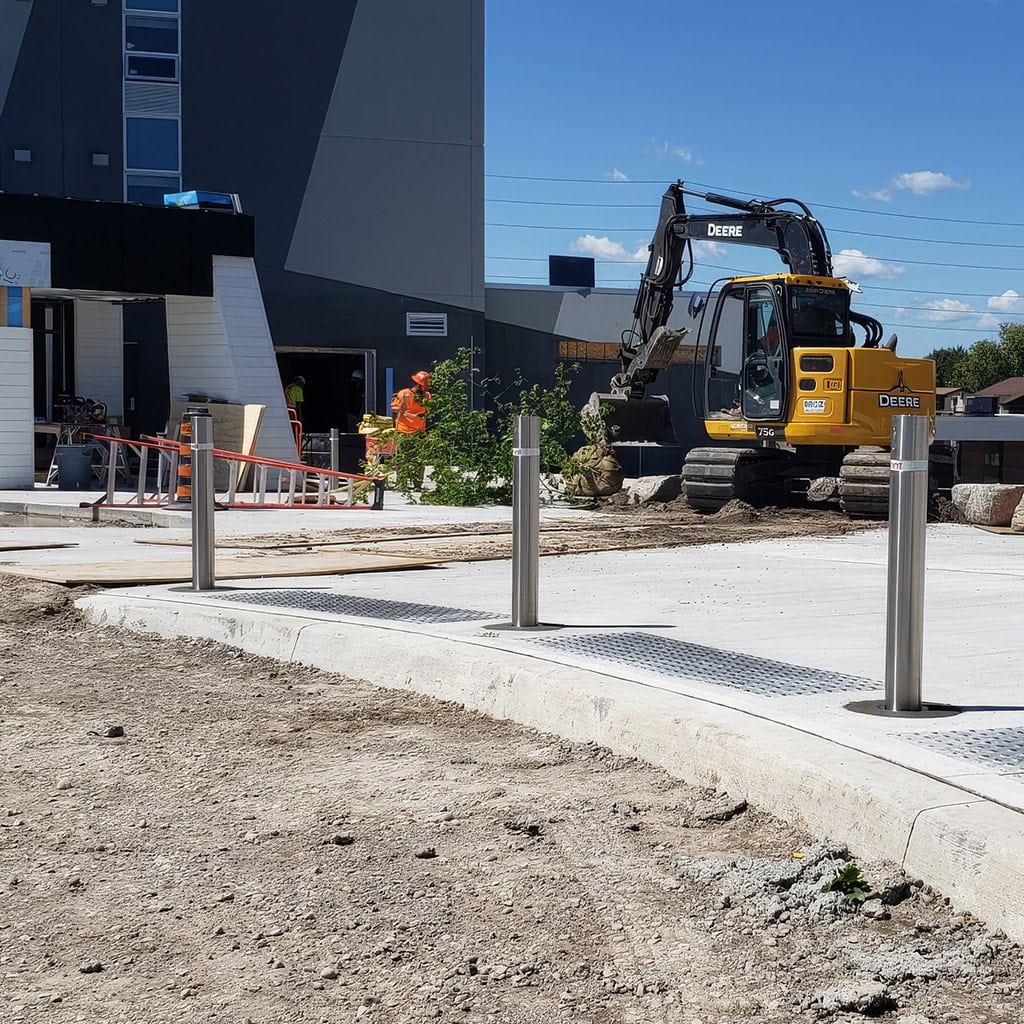
Review All Drawings for Bollard Locations
Bollards are easy to miss. It is one of the most common reasons that bollards cause problems.
Unlike major building systems, bollards do not live in one predictable place within a drawing package. Depending on the project and consultant, they may appear in:
- Architectural plans
- Civil or site drawings
- Landscape drawings
- Enlarged plans or partial details
- General notes or keyed callouts
- Specifications without a clear plan reference
In some cases, bollards only show up in a single, enlarged detail or as a note referencing typical bollards at exposed conditions. If the drawing review focuses only on architectural or civil sheets, the scope can be partially or completely missed.
Bollards require a full-set review, not a discipline-by-discipline skim.
Coordinate Bollard Installation in Advance
Bollards require early consideration. Problems typically arise because bollards are seen as a minor line item rather than as a part of a coordinated installation.
This is not a scope ownership issue; it is a prioritization issue.
- Assumptions are made early about quantities, locations, installation methods, and protection levels
- These assumptions frequently go unchallenged until excavation or drilling begins
- By the time conflicts surface, the project is already under schedule pressure
Bollard issues are best mitigated through deliberate early review, coordination, and field validation.
Who Owns Bollard Scopes on Commercial Projects?
Bollards are often carried under the General Contractor scope or managed by the GC through subcontractors.
Ownership disputes do happen, especially when bollards appear in multiple drawing packages or are noted only in specifications. It is important to verify ownership up front.
Even when there is clear ownership, it does not mean clear execution.
Confirm Bollard Suitability For Real Site Conditions
This is the biggest issue.
Most bollard problems and delays are caused by incorrect or unsuitable bollard selection.
Common mismatches include:
- Diameter: Too small to provide meaningful vehicle protection
- Embedment depth: Insufficient for soil conditions
- Impact Resistance: If the intent is vehicle mitigation, a crash-rated system is required rather than a generic site bollard
- Spacing: Too wide to prevent vehicle intrusion
- Protection level: Decorative bollards specified where protection is required
- Finish or coating: Not suitable for long-term environmental exposure or durability
A bollard may technically comply with what is shown on paper, yet still fail in real-world conditions. For example, a light-wall steel pipe with minimal embedment may match a drawing detail but still provide limited real-world vehicle protection.
This is where projects often run into late redesigns, inspection issues, or post-install concerns from owners or consultants. Bollard suitability must be evaluated beyond what is shown on the drawings. Meeting the detail does not always mean meeting the intent.
Quick Bollard Suitability Checklist
Before installation, confirm the following:
- What is the functional intent of each bollard (protective vs. decorative)
- Does each bollard match the actual vehicle exposure at its location
- Is bollard diameter, wall thickness and embedment depth adequate for its function and location
- Are bollards spaced and aligned to fully protect the asset
- Are they spaced to any applicable ADA or accessibility clearance requirements
- Can bollards be installed given site conditions (utilities, slab thickness, access)
- Are finishes suitable for long-term exposure and site environment
- Are removable bollards and sleeves being used (if so, coordination risks increase)
Confirm Bollard Installation Intent in the Field
Many bollard-related issues stem from missing installation intent. Drawings will often imply conditions that do not exist in the field.
Commonly undefined or assumed conditions include:
- Finished grade versus actual site elevations
- Underground utility conflicts discovered during excavation
- Assumed concrete slab thickness or reinforcement
- Soil conditions that affect embedment performance
- Access limitations for drilling or excavation equipment
- Whether bollards are intended to be protective, decorative or both
- Freeze/thaw climates that affect long-term performance and alignment
- Alignment, spacing, and tolerance expectations
Because these items are often not explicitly documented, they get resolved reactively after excavation has started or when concrete is already placed. At that point, fixes become expensive and disruptive.
A Practical Rule for GCs Before Excavation Or Core Drilling Begins
Before any excavation or core drilling begins, General Contractors should:
- Confirm the full bollard scope across all drawings and specifications
- Verify that the specified bollard is appropriate for the actual application
- Validate site conditions through a field verification visit
An early walk of bollard locations, especially near doors, overhead loading areas, utilities and slabs, can uncover conflicts that are invisible on paper. This is the moment when adjustments are easy and inexpensive.
Waiting until excavation or drilling begins is when small issues turn into schedule impacts.
Early Validation Prevents Late-Stage Problems
Bollards may be small components within a commercial project, but the consequences of getting them wrong are not. Missed scope, unsuitable protection, or unaddressed site constraints can quickly lead to delays, construction rework, and frustration across multiple trades.
When addressed early and intentionally, bollards are straightforward to execute.
For General Contractors, a small investment of time up front to review, analyze and verify in the field can eliminate a long list of downstream problems.