
How to Manage Bollard Scope and Avoid Rework on Commercial Construction Projects
Bollards are often treated as minor site elements. In reality, bollards sit at the intersection of safety, structure, underground utilities, and trade coordination.
When they are overlooked or under-analyzed early, they can create unnecessary problems late in the schedule.
Missed scope, redesigns, utility conflicts, failed inspections, or last-minute change orders related to bollards are common on commercial construction projects. The root cause is rarely negligence; it is that bollards are assumed to be straightforward when they are not.
This article is intended as a practical, field-based guide to help General Contractors proactively manage bollard scope and execution, reduce rework and avoid unnecessary delays.
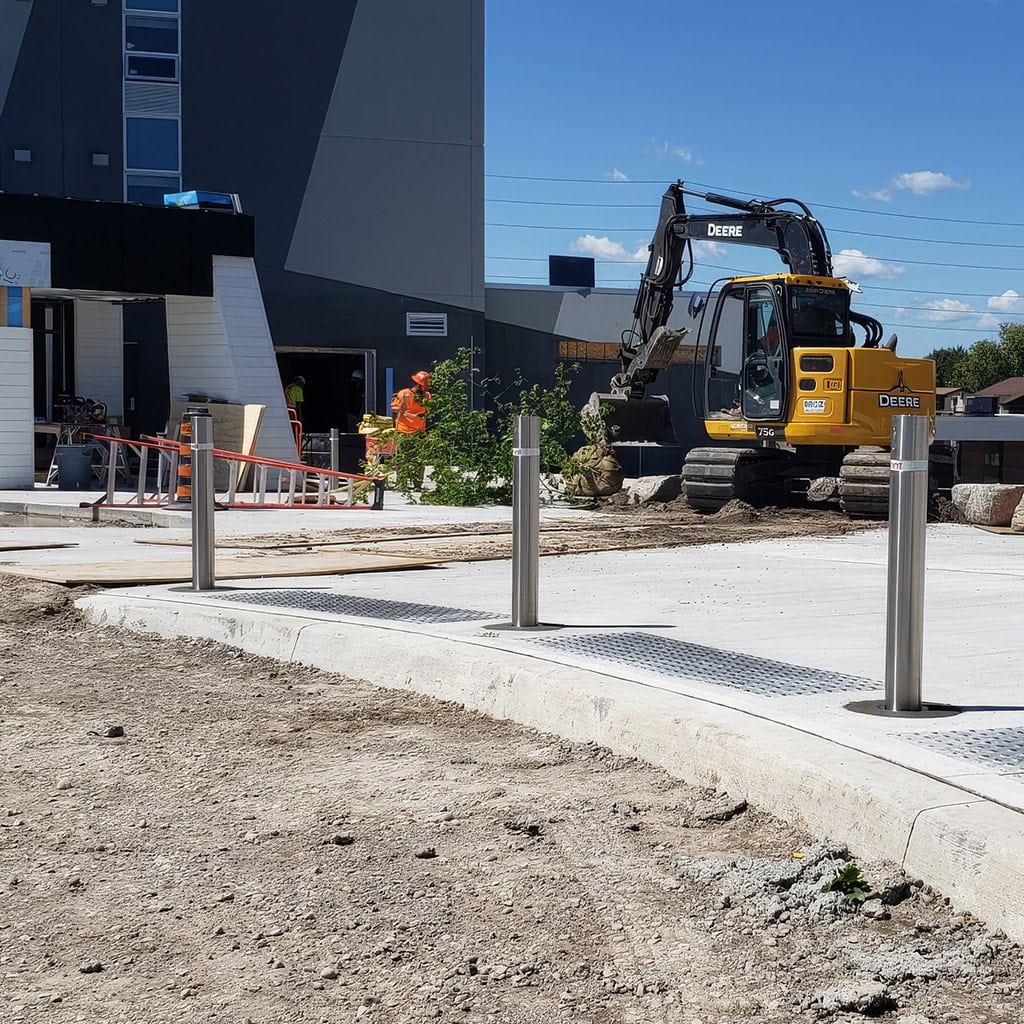
Review All Drawings for Bollard Locations
Bollards are easy to miss. It is one of the most common reasons that bollards cause problems.
Unlike major building systems, bollards do not live in one predictable place within a drawing package. Depending on the project and consultant, they may appear in:
- Architectural plans
- Civil or site drawings
- Landscape drawings
- Enlarged plans or partial details
- General notes or keyed callouts
- Specifications without a clear plan reference
In some cases, bollards only show up in a single, enlarged detail or as a note referencing typical bollards at exposed conditions. If the drawing review focuses only on architectural or civil sheets, the scope can be partially or completely missed.
Bollards require a full-set review, not a discipline-by-discipline skim.
Coordinate Bollard Installation in Advance
Bollards require early consideration. Problems typically arise because bollards are seen as a minor line item rather than as a part of a coordinated installation.
This is not a scope ownership issue; it is a prioritization issue.
- Assumptions are made early about quantities, locations, installation methods, and protection levels
- These assumptions frequently go unchallenged until excavation or drilling begins
- By the time conflicts surface, the project is already under schedule pressure
Bollard issues are best mitigated through deliberate early review, coordination, and field validation.
Who Owns Bollard Scopes on Commercial Projects?
Bollards are often carried under the General Contractor scope or managed by the GC through subcontractors.
Ownership disputes do happen, especially when bollards appear in multiple drawing packages or are noted only in specifications. It is important to verify ownership up front.
Even when there is clear ownership, it does not mean clear execution.
Confirm Bollard Suitability For Real Site Conditions
This is the biggest issue.
Most bollard problems and delays are caused by incorrect or unsuitable bollard selection.
Common mismatches include:
- Diameter: Too small to provide meaningful vehicle protection
- Embedment depth: Insufficient for soil conditions
- Impact Resistance: If the intent is vehicle mitigation, a crash-rated system is required rather than a generic site bollard
- Spacing: Too wide to prevent vehicle intrusion
- Protection level: Decorative bollards specified where protection is required
- Finish or coating: Not suitable for long-term environmental exposure or durability
A bollard may technically comply with what is shown on paper, yet still fail in real-world conditions. For example, a light-wall steel pipe with minimal embedment may match a drawing detail but still provide limited real-world vehicle protection.
This is where projects often run into late redesigns, inspection issues, or post-install concerns from owners or consultants. Bollard suitability must be evaluated beyond what is shown on the drawings. Meeting the detail does not always mean meeting the intent.
Quick Bollard Suitability Checklist
Before installation, confirm the following:
- What is the functional intent of each bollard (protective vs. decorative)
- Does each bollard match the actual vehicle exposure at its location
- Is bollard diameter, wall thickness and embedment depth adequate for its function and location
- Are bollards spaced and aligned to fully protect the asset
- Are they spaced to any applicable ADA or accessibility clearance requirements
- Can bollards be installed given site conditions (utilities, slab thickness, access)
- Are finishes suitable for long-term exposure and site environment
- Are removable bollards and sleeves being used (if so, coordination risks increase)
Confirm Bollard Installation Intent in the Field
Many bollard-related issues stem from missing installation intent. Drawings will often imply conditions that do not exist in the field.
Commonly undefined or assumed conditions include:
- Finished grade versus actual site elevations
- Underground utility conflicts discovered during excavation
- Assumed concrete slab thickness or reinforcement
- Soil conditions that affect embedment performance
- Access limitations for drilling or excavation equipment
- Whether bollards are intended to be protective, decorative or both
- Freeze/thaw climates that affect long-term performance and alignment
- Alignment, spacing, and tolerance expectations
Because these items are often not explicitly documented, they get resolved reactively after excavation has started or when concrete is already placed. At that point, fixes become expensive and disruptive.
A Practical Rule for GCs Before Excavation Or Core Drilling Begins
Before any excavation or core drilling begins, General Contractors should:
- Confirm the full bollard scope across all drawings and specifications
- Verify that the specified bollard is appropriate for the actual application
- Validate site conditions through a field verification visit
An early walk of bollard locations, especially near doors, overhead loading areas, utilities and slabs, can uncover conflicts that are invisible on paper. This is the moment when adjustments are easy and inexpensive.
Waiting until excavation or drilling begins is when small issues turn into schedule impacts.
Early Validation Prevents Late-Stage Problems
Bollards may be small components within a commercial project, but the consequences of getting them wrong are not. Missed scope, unsuitable protection, or unaddressed site constraints can quickly lead to delays, construction rework, and frustration across multiple trades.
When addressed early and intentionally, bollards are straightforward to execute.
For General Contractors, a small investment of time up front to review, analyze and verify in the field can eliminate a long list of downstream problems.
Comments are closed