
How Far Apart Should Bollards Be Placed?
A Guide for Landscape Architects & Security Specifiers
Quick Answer: Typical Bollard Spacing at a Glance
-
Most sites: Place bollards 3–5 feet (0.9–1.5 m) apart, measured from the center of one post to the next.
-
Accessibility (ADA): Leave at least 36 inches (0.9 m) of clear space for wheelchairs and walkers.
-
Vehicle safety: Gaps should be no larger than 5 feet (1.5 m). For high-security areas, reduce spacing to 4 feet (1.2 m) or less.
-
Important: Always check local building codes before finalizing your layout.
Why Spacing Matters: People, Safety, and Design
Good bollard placement is about balance:
-
People first: Bollards should allow smooth pedestrian flow, including those using wheelchairs, strollers, or mobility aids.
-
Safety: They must be close enough to stop vehicles from sneaking through, especially in front of storefronts, schools, or public plazas.
-
Design: Bollards should line up neatly with benches, trees, planters, and lights. This makes the space look organized and welcoming.
Your goal matters too. A storefront protection line will need tighter spacing than a decorative walkway on a campus.

Spacing Rules by Application
Pedestrian & ADA Access
-
Keep at least 36 inches (0.9 m) of clear width for accessibility.
-
In busy areas, give a little more room (42–48 inches) for comfort.
-
Always measure from the outside of the sleeve or cover — not just the post.
Vehicle Deterrence & Storefront Protection
-
Standard safety: Gaps no larger than 5 feet (1.5 m).
-
Higher risk: Tighten to 4 feet (1.2 m) or less.
-
Match spacing to the likely vehicle approach angle and speed.
Sidewalks Next to Parking
-
Set bollards back about 1.5 feet (0.45 m) from the curb.
-
This gives people enough space to open car doors.
-
Leave extra room near accessible parking spaces.
Campuses, Schools, and Plazas
-
Use a steady rhythm of 4–5 feet (1.2–1.5 m) apart.
-
Keep clear “desire lines” where people naturally walk.
-
Make sure emergency vehicles can still get through.
Utility and Asset Protection
-
For sensitive equipment, keep bollards 4 feet (1.2 m) or closer.
-
Consider adding rails or barriers for extra protection.
-
Don’t block maintenance crews from reaching equipment.
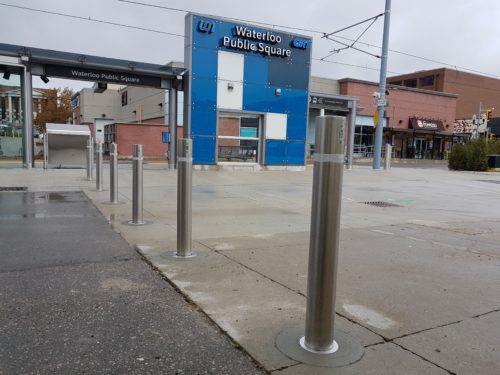
Spacing Summary Table
| Use Case | Recommended Spacing | Notes |
|---|---|---|
| Pedestrian / ADA | ≥36 in (0.9 m) clear width | Measure at narrowest point |
| Vehicle Deterrence | ≤5 ft (1.5 m) gap | ≤4 ft (1.2 m) for higher risk areas |
| Sidewalk by Parking | ~1.5 ft (0.45 m) from curb | Allows car doors to open |
| Campuses / Plazas | 4–5 ft (1.2–1.5 m) | Comfort + natural walking patterns |
| Utilities / Assets | ≤4 ft (1.2 m) or add rails | Based on asset importance |
Codes and Standards (Simplified)
-
ADA (Accessibility): At least 36 inches of clear space for people using mobility devices. Local versions may add more rules.
-
ASTM F2656 (Crash Testing): A U.S. crash standard. Some tested bollards only work if placed in a certain pattern — always follow manufacturer instructions.
-
Building Codes: Check International Building Code (IBC) and local rules for exits, sightlines, and fire department access.
-
Traffic Standards (MUTCD): Guidelines for bollards near crosswalks, schools, and intersections.
Note: Local planning departments have the final say. Always confirm with them before construction.
Layout Details: Lines, Corners, and Openings
-
Measurement: Measure from center to center. Don’t forget the sleeve width.
-
Corners: Place bollards closer together to stop diagonal vehicle movement.
-
Access Points: Leave 6–8 feet for gates, deliveries, or emergency access. Use removable or automatic bollards where needed.
-
Site Planning: Check for drainage, underground utilities, snow removal, and seasonal furniture.

Common Mistakes to Avoid
-
Measuring wrong: Forgetting to include sleeves or covers. Always measure the narrowest clear opening.
-
Corner gaps: Leaving wide angles that vehicles can cut through. Tighten bollards at corners.
-
Curb clearance issues: Placing bollards too close to curbs so car doors can’t open. Keep that 1.5-foot offset.
-
Code conflicts: Meeting one rule but breaking another. Always design to the strictest code.
Frequently Asked Questions
Q: What is the standard distance between bollards?
A: Usually 3–5 feet apart, depending on security and accessibility needs.
Q: What is ADA-compliant clear width?
A: At least 36 inches (0.9 m) between bollards at the narrowest point.
Q: How close should bollards be for vehicle safety?
A: No more than 5 feet (1.5 m) apart. High-security areas should be 4 feet (1.2 m) or less.
Q: How far back from the curb should bollards be?
A: About 1.5 feet (0.45 m) to allow doors to open.
Q: Do decorative sleeves change spacing?
A: Yes. Measure spacing at the outer edge of the sleeve, not the post.
Getting Started: Your Next Steps
-
Download CAD/Revit details for ready-to-use layouts.
-
Request a site review from our team for project-specific advice.
Checklist before finalizing your design:
-
Clear width meets ADA rules
-
Local codes verified
-
Vehicle gaps under control
-
Corners secured
-
Emergency access allowed
-
Utilities and drainage checked
Ontario Bollards’ Perimeter Protection Team has extensive experience with both crash-rated and architectural bollards. Need help with your next project? Contact our team for site-specific support.